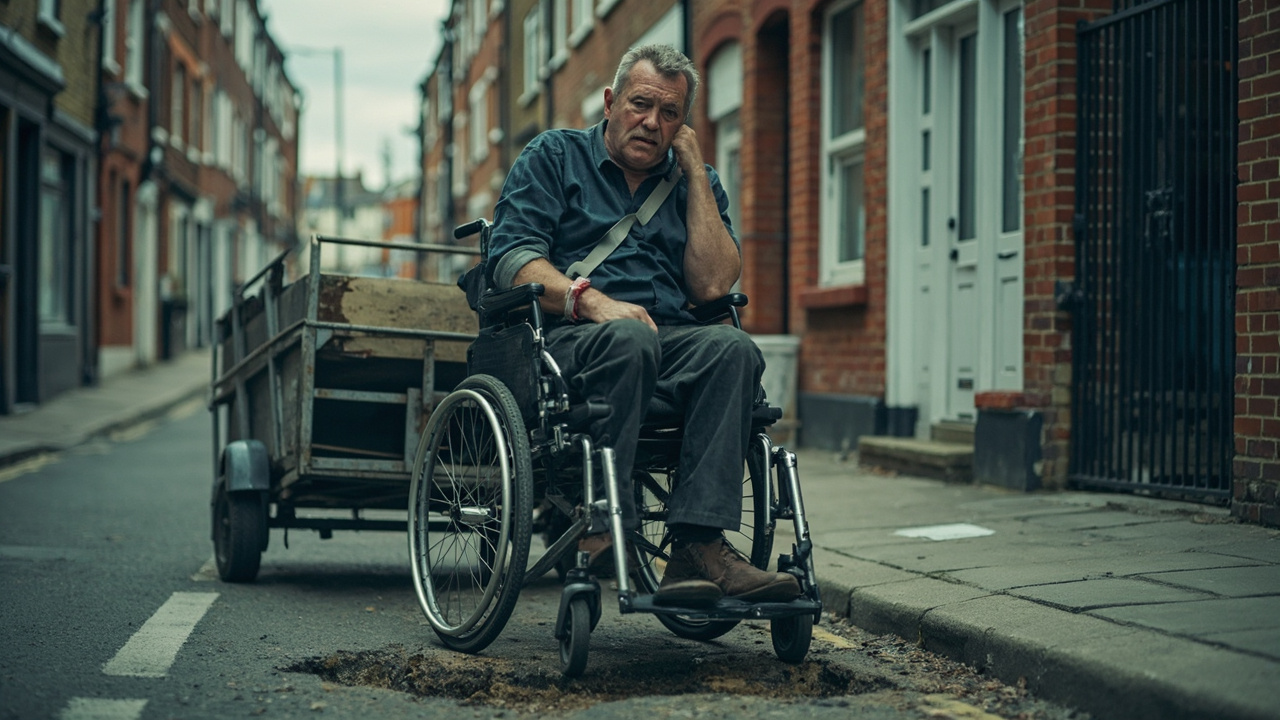

A man from Hackney has been forced to stop his wheelchair expedition across Britain after being taken to hospital.
Peter Smorthit, 34, from Hoxton, had been aiming to cover the distance between Land’s End and John O’Groats and then return, with the goal of collecting funds for charity.
Last week he suffered a broken collarbone when the supply trailer attached to his wheelchair encountered a pothole as he approached Cheddleton Village in Staffordshire.
He was collecting money for Canine Partners (Image: Peter Smorthit)
The trailer became stuck in the pothole on a slight downhill stretch, throwing him from his chair. He sustained injuries severe enough to require hospitalisation.
The accident happened after he had already covered 1,700 miles over 62 days.
Medical staff kept him in hospital for nearly two days before allowing him to leave. He is now waiting for an operation but remains optimistic about resuming the challenge in future.
Peter at Land’s End (Image: Peter Smorthit)
He plans to return and finish the route as soon as he has recovered sufficiently, he told the Gazette.
Peter has used a wheelchair since 2011, when his spinal cord was damaged during a scaffolding collapse while he was working on a construction site at the age of 19.
This has not prevented him from seeking adventure, and he has since become a highly active endurance wheelchair competitor.
He has finished 235 marathons and 160 ultramarathons, and has previously made the solo trip from Land’s End to John O’Groats in his wheelchair several times.
He explained that his goal extends beyond personal challenge to demonstrating what wheelchair users can achieve.
Despite the setback, Peter collected more than £11,000 for his selected cause, Canine Partners, an organisation that breeds and trains assistance dogs for people with disabilities.
Peter was attempting to go from Land’s End to John O’Groats and back again (Image: Peter Smorthit)
He noted that such charities operate on a modest scale and often do not receive the public recognition they merit. He wanted to draw attention to their valuable work.
Before the injury, he said the most memorable part of the expedition had been navigating through the Scottish Highlands. The climbs were extremely demanding, with some gradients being particularly severe, but reaching the summits made the effort worthwhile, he explained.