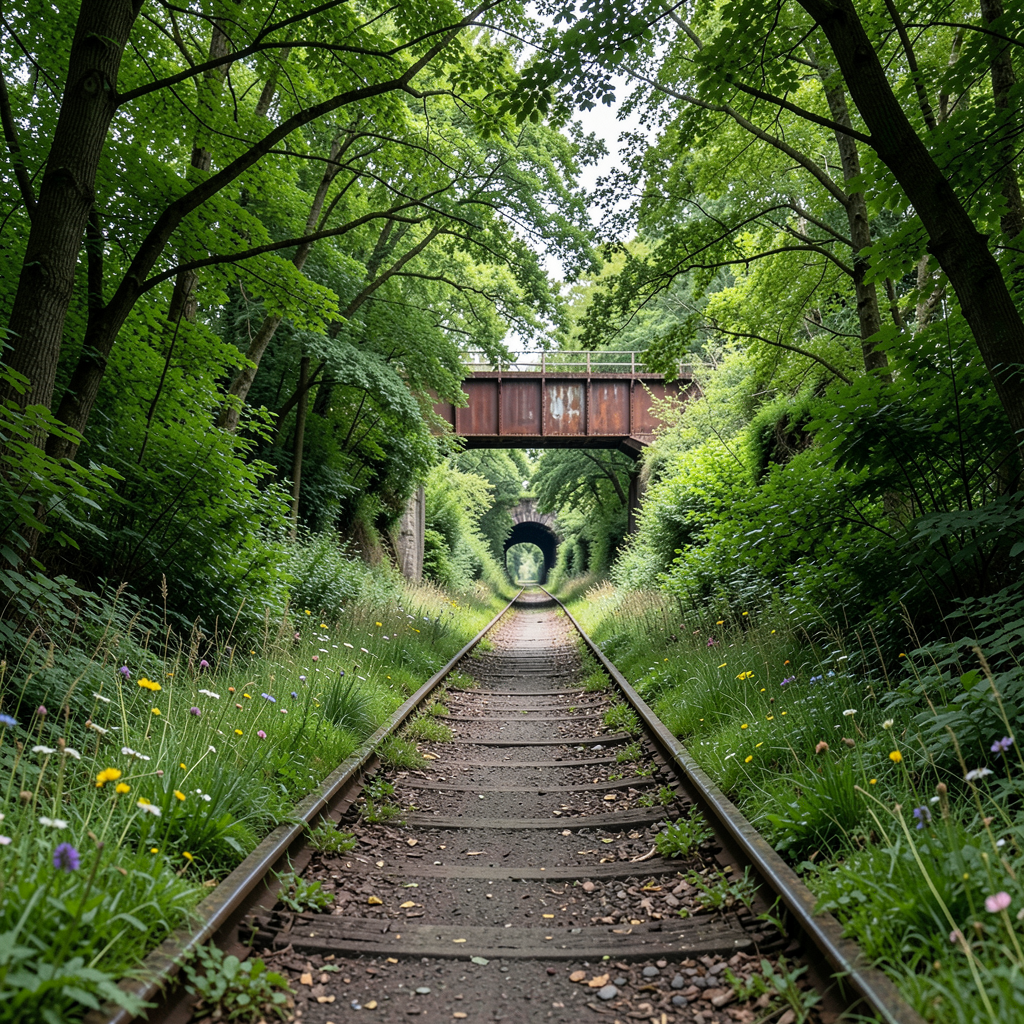

The north London district of Crouch End frequently appears at the summit of surveys ranking the capital’s most desirable areas to live, despite lacking its own underground railway station.
An examination of historical transport proposals reveals what might have transpired had infrastructure upgrades proceeded as planned during the mid-twentieth century.
The cluster of independent retailers, cinema venues, and regular community arts celebrations which define the area could have presented a markedly different character had residents possessed direct access to the Northern line via Finsbury Park rather than relying exclusively on local bus services.
Passenger rail operations from Crouch End concluded their final journey in 1954.
Approximately thirty years subsequent to this closure, the former railway corridor became formally integrated into the Parkland Walk, establishing London’s most extensive nature reserve situated along an abandoned rail alignment.
During 1935, steam-powered services operated between Alexandra Palace and Finsbury Park, serving the Crouch End community.
The original facility had commenced operations in 1867, established by the Great Northern Railway and positioned on the eastern flank of Crouch End Hill.
The 1930s witnessed the formulation of ambitious proposals by the London Passenger Transport Board involving significant network enhancements.
These plans encompassed the conversion of the branch line into an extension of the Northern line, representing a substantial transformation of suburban rail infrastructure.
Had construction proceeded as designed, the route would have connected Finsbury Park with Stroud Green, subsequently extending to Crouch End, Highgate, Cranley Gardens, Muswell Hill, and Alexandra Palace.
A new interchange at Finsbury Park would have facilitated continued progression through Highbury and Islington, delivering rapid and regular electric services into central London.
Preliminary construction activities did commence, with platform reconstruction undertaken at Crouch End involving concrete and brick materials.
These modifications were designed to accommodate both conventional main line rolling stock and underground railway vehicles.
However, the outbreak of the Second World War in 1939 resulted in the immediate suspension of all construction activities.
Official Tube maps continued to depict the proposed Northern line branch as a project under development until 1950, though work never resumed following the conflict’s conclusion.
The existing passenger service deteriorated considerably during this period, operating with antiquated Victorian-era rolling stock.
It became increasingly evident that continued operation could not be sustained indefinitely.
A 1953 assessment concluded that passenger volumes failed to justify the expense of electrification infrastructure.
The facility ceased accepting passengers during 1954.
The railway tracks were subsequently lifted, while station structures and staircases were demolished, though the platform surfaces themselves persisted in situ.
Rather than acquiring a dedicated Tube connection, north London residents instead received an extensive green corridor dedicated to pedestrian recreation and outdoor pursuits.
The evocative abandoned station complex has also served as a filming location for various productions.
By 1976, Haringey Council had formally designated the segment between Cranley Gardens and Alexandra Park as the Parkland Walk.
Several years subsequently, the portion connecting Finsbury Park and Highgate underwent similar development, with pathway resurfacing and enhanced accessibility implemented along the former railway formation.
The Parkland Walk received its official inauguration during 1984.
The resulting 3.9-mile walkway and cycle route now constitutes London’s largest nature reserve, providing an important recreational and ecological resource for local communities.