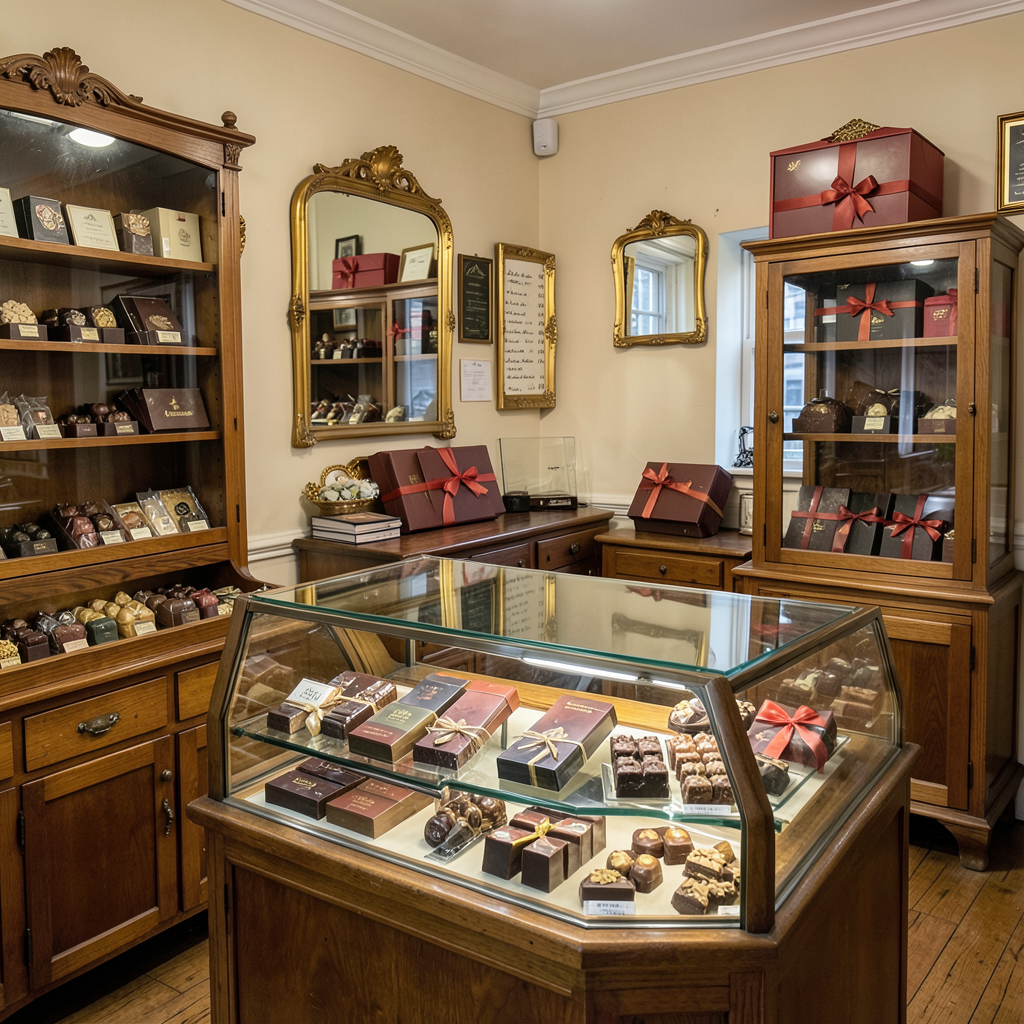

A Jewish refugee family operated a renowned artisan chocolate-making enterprise from a north London basement for half a century before closing twenty years ago.
Werner and Lotte Ackerman established Ackermans Chocolates at Goldhurst Terrace, building a business that would eventually receive royal recognition during the post-war period.
In Berlin during the 1930s, Werner worked as a legal professional while Lotte pursued a career as a classically trained musician.
The political climate under Nazi rule made their situation increasingly precarious.
Lotte’s family connections to the Kempinski hospitality empire, which operated multiple establishments serving Berlin’s population, provided an essential opportunity for escape.
Hans Kempinski, a co-proprietor of the family business, had carefully investigated possibilities for relocating abroad as political conditions deteriorated.
In 1935, he secured authorization from British immigration authorities to establish a German restaurant on Swallow Street in Piccadilly.
This venture enabled the transfer of personnel from Germany to England.
The Ackermans received offers of employment at the London establishment, presenting them with a route out of Europe.
Lotte acquired confectionery expertise while working at Kempinski’s Berlin premises, which proved instrumental in enabling their departure when the company opened a London branch.
According to their grandson Nicholas Rose, who authored a book titled From Berlin to Bittermints published by The Choir Press earlier this year, the pair were required to prove their catering abilities before relocating.
Both individuals had minimal culinary experience prior to this point, with their pre-war lives focused on law and music respectively.
Between April 1935, they spent twelve months working in the Kempinski kitchens on Kurfürstendamm in Berlin.
Lotte specialized in pastry preparation, producing after-dinner chocolates and small fancy cakes, while Werner learned the technique for creating Baumkuchen, a traditional German layered cake.
The couple relocated in 1936 to an apartment on Thurlow Road in Hampstead, with their benefactors residing in the floors above.
Lotte commenced employment at the restaurant while Werner attempted to prepare Baumkuchen at home using equipment he had transported from Germany.
However, the reduced gas pressure prevalent in British homes affected the moisture content of his cakes, and there was insufficient demand for such an upscale product.
When hostilities commenced in 1940, Werner found himself detained on the Isle of Man under regulations applicable to enemy aliens, a fate shared with numerous German-speaking newcomers to Britain.
His release came only after he enlisted in the Pioneer Corps.
During his military service abroad, Lotte established a supplementary enterprise producing chocolates from her domestic kitchen.
Despite the constraints of wartime rationing affecting both sugar and cocoa supplies, she benefited from connections with Max Weldon, a fellow refugee working in the cocoa trade who had established relationships with Caxton, a company dealing in industrial-grade chocolate suitable for confectionery use.
Lotte commenced production on her kitchen surface, supported by other displaced women, and distributed the completed items throughout their social network.
Following Werner’s discharge from military service in August 1945, the couple dedicated themselves entirely to their confectionery enterprise.
They identified a market opportunity for continental-style dark chocolate products, which were not widely available in Britain at that time.
In a workspace situated in Fairfax Mews near Finchley Road, an assistant enabled Lotte to expand production while Werner attended to customers.
Their inaugural permanent retail location opened on Kensington Church Street in 1952, coinciding conveniently with the abolition of chocolate rationing the following year.
Werner implemented distinctive window displays to attract attention and cultivate a discerning customer base.
A second establishment followed in 1956 at premises on Goldhurst Terrace off Finchley Road, with manufacturing operations transferred to a basement workshop.
Their concentration on dark chocolate, which remained unconventional among British consumers who traditionally favoured milk varieties, together with continental offerings such as marzipan confections, distinguished them from competitors.
The establishment gained favour with members of the royal household.
Princess Alexandra, whose official residence stood near their Kensington premises, was among their earliest royal patrons and frequented the store personally.
Princess Margaret and the Queen Mother subsequently became regular customers.
Chocolate selections were routinely delivered by hand to both Kensington Palace and Clarence House whenever requested, resulting in the granting of a Royal Warrant in 1968.
This distinction permitted the use of royal insignia on packaging, specifically acknowledging the company as confectioners supplying the Queen Mother.
During busy periods, considerable lines would form outside the Goldhurst Terrace location, which functioned as a gathering point for the émigré community.
Lotte demonstrated exceptional skill as a chocolate maker, mastering the techniques required to achieve the characteristic sheen and full-bodied flavour that distinguishes superior chocolate.
Werner’s strength lay in customer relations, though he lacked ability in packaging, and wisely assembled a workforce of fellow refugees to manage the retail counter.
By 1978, the couple had both passed their seventies and continued to manage operations despite cardiac health issues.
They chose to conclude their involvement and transfer the business to Werner Krattiger, a young Swiss pastry chef whom they had originally hired as an apprentice.
Krattiger proceeded to develop the company significantly, preserving the Goldhurst Terrace outlet while relocating production to a commercial facility in Camden.
Under his direction, weekly output escalated to four thousand kilograms, representing a dramatic increase from the approximately one hundred kilograms that Lotte and her collaborators had originally managed.
Tragically, Krattiger contracted Aids and passed away in 1992 at the age of forty-two.
His testamentary arrangements created a foundation to sustain Ackermans Chocolates, with a portion of earnings directed towards medical research into the disease.
The company established distribution arrangements with overseas contacts, achieving temporary availability in KaDeWe, the celebrated Berlin department store often described as Germany’s equivalent of Harrods.
A subsequent royal connection emerged when the future King Charles III visited Selfridges in 1996, where Ackermans maintained a concession in the revamped Food Hall.
This exposure led to a commercial agreement to supply the Duchy Originals collection with their distinctive thin mints, a confection developed by Lotte that Nicholas describes as her most significant contribution to the British chocolate trade.
During the late 1990s, Charbonnel et Walker acquired a controlling interest in the company, maintaining the Ackermans brand identity for a period.
Following the Queen Mother’s passing in 2002, the Royal Warrant was necessarily revoked, and the brand along with the Goldhurst Terrace establishment eventually ceased operations.
Nicholas retrieved the original storefront sign during refurbishment work, and it now occupies a prominent position in his kitchen as a memento of his grandparents and their considerable accomplishments.