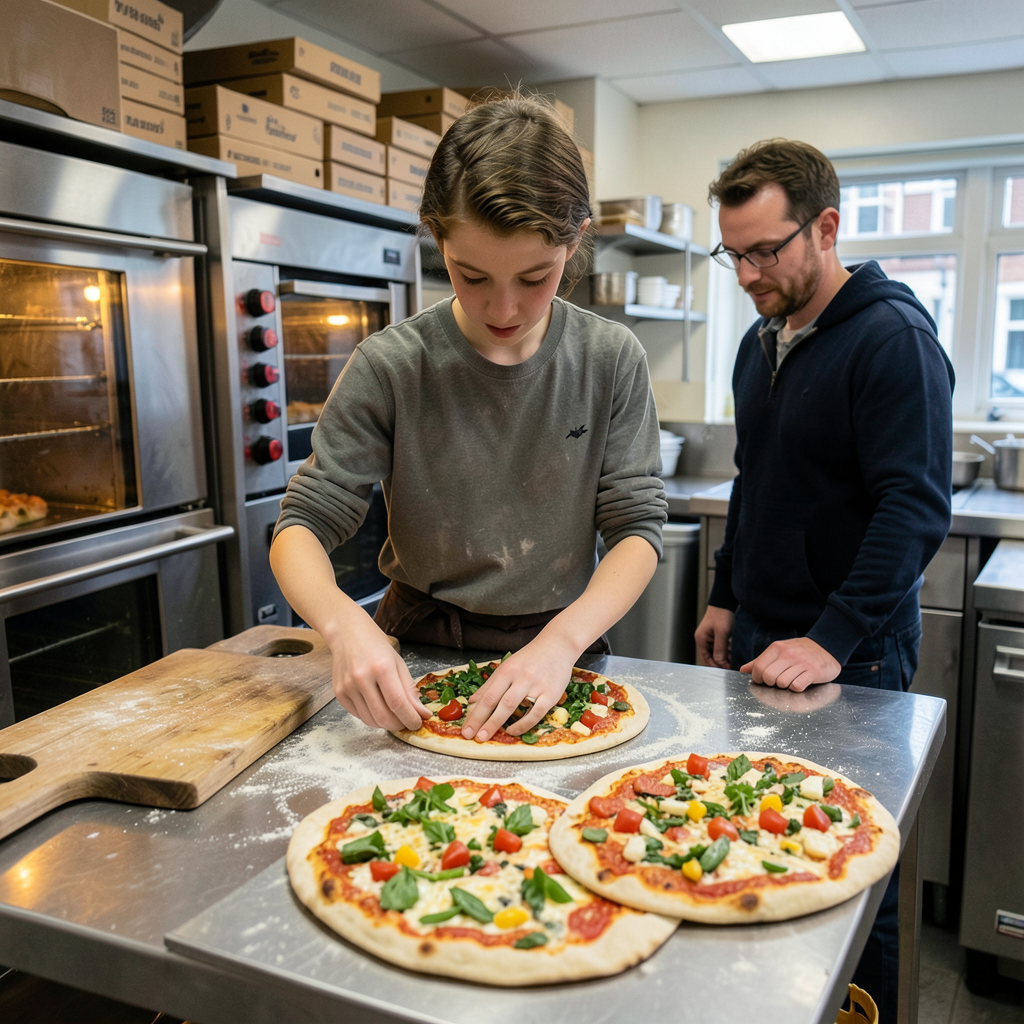

A mother from Kentish Town has established a pizza delivery service designed to create employment pathways for autistic young adults.
Aparna Bangur developed the concept for Pizza Party after witnessing her 14-year-old son Aarav’s enthusiasm for the Italian staple.
The operation functions from a commercial kitchen on Regis Road and offers a concise selection of crispy, vegetable-focused pizzas in the London style.
Deliveries are available across north London through Deliveroo and Uber Eats platforms.
The menu features a straightforward offering, with the dough recipe comprising just five components.
However, the underlying purpose extends far beyond standard takeaway operations.
The venture addresses a significant shortfall in employment opportunities for autistic adults, with official figures indicating that merely 34 per cent of autistic disabled individuals in the United Kingdom maintain employment, compared to 82 per cent of their non-disabled counterparts.
Aparna intends to bridge this gap by providing autistic young adults with practical experience within a supportive kitchen environment.
Trainees will develop competencies in food preparation, hospitality operations, kitchen procedures and client-facing roles.
For Aarav specifically, pizza represents comfort through its predictability and familiarity.
The Kentish Town kitchen is preparing to accept its inaugural cohort of participants through the Pizza Party Prep internship initiative, established in collaboration with the learning disability charity Mencap.
The kitchen environment offers structured, repetitive tasks that can be systematically taught, alongside opportunities for advancement.
Participants produce genuine dishes for actual customers within an operating enterprise.
Upon completing the internship, individuals should have developed increased assurance and familiarity with hospitality sector expectations, in addition to mastering production of the establishment’s signature five-ingredient dough.
As the venture expands, Aparna intends to retain qualified trainees as staff members.
The long-term objective involves launching a physical pizzeria where autistic young adults can be observed acquiring skills and earning income.
Beyond direct employment, placement opportunities with other pizza establishments and food service companies are being developed.
Success will be measured not by completion rates but by whether the experience creates subsequent opportunities.
The brand presentation emphasises vibrant, saturated design elements with an approachable aesthetic, serving areas including Camden, Islington, Barnet, Westminster and the City of London.
The objective is to enhance visibility of autistic young people within the employment sector, demonstrating that such enterprises can simultaneously pursue commercial objectives while generating meaningful prospects for neurodiverse individuals.