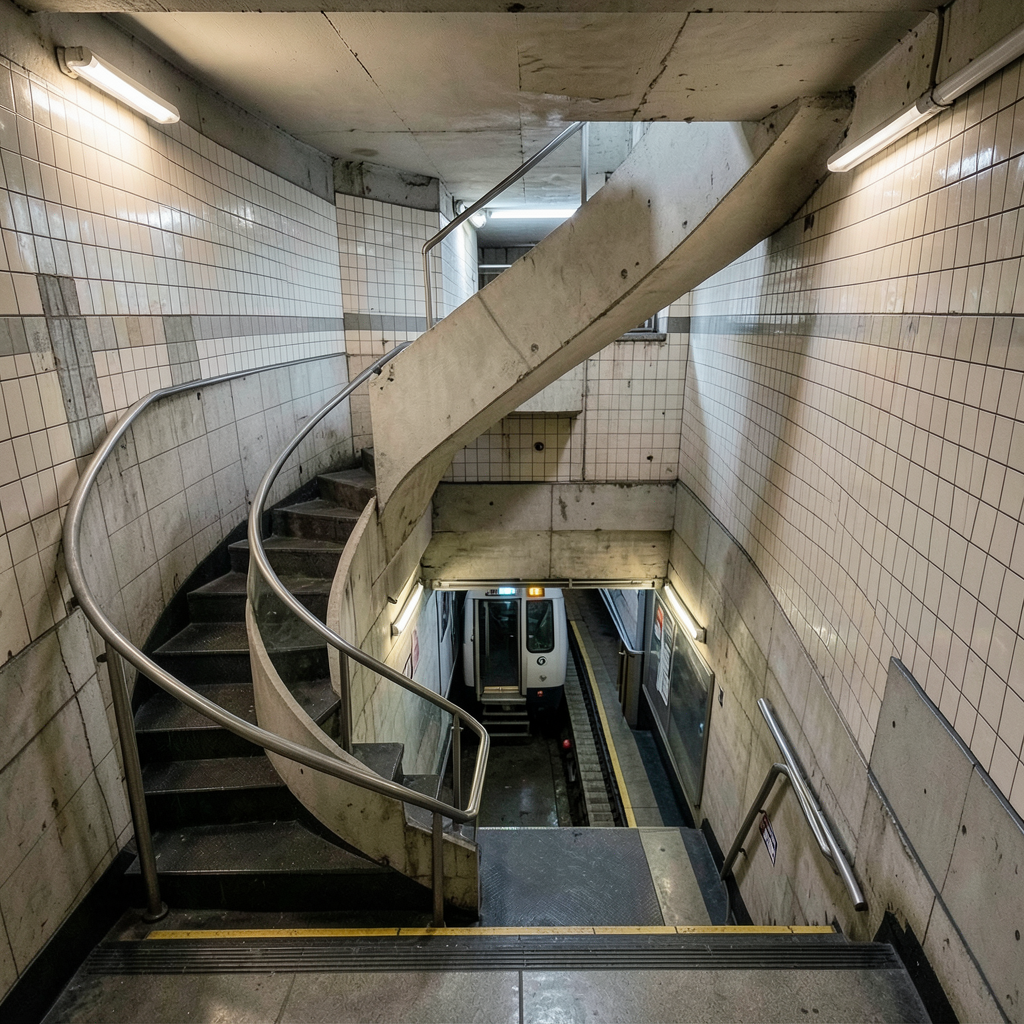

Hampstead Underground station, which opened on 22 June 1907 almost 120 years ago, holds the record for being the deepest point on the London Underground network.
Its platforms lie 58.5 metres, or 192 feet, beneath street level.
The lift shaft descends 55 metres, or 180 feet, while a spiral staircase of 320 steps provides access between the platforms and the surface entrance.
Signs warn against using the staircase in emergencies because its climb is comparable to ascending a 15-storey building.
The station occupies the junction of Heath Street and Hampstead High Street.
Original tiled signs on the platform walls still display Heath Street, the proposed name, although it was subsequently changed.
Hampstead station is served by the Edgware branch of the Northern line, positioned between Golders Green and Belsize Park, with lifts remaining the principal means of travelling between street level and the platforms.
The arrival of the expanding Underground network gave the previously quiet village direct links to central London.
It also stimulated suburban growth towards Golders Green and areas further north.
Hampstead had attracted visitors since the 18th century because of its mineral waters.
Working-class crowds later travelled to the Heath on bank holidays for gatherings known as ‘appy ‘ampstead.
Two historic images are held by Burgh House in Hampstead.
One depicts the station site around 1900, while the other shows it at the time of its opening.
The extension of the Underground to Hampstead supported further development in the surrounding area.
The Charing Cross, Euston and Hampstead Railway was first proposed in 1893, but construction was delayed for a decade.
American financier Charles Tyson Yerkes took control of the scheme in 1900 and revised it as an electric underground railway.
Since the station stood beneath a hill, the route required tunnels to pass below the terrain and lifts to carry passengers between the platforms and street level.
Hampstead was among 50 Underground stations designed by Leslie Green between 1903 and 1907.
His use of glazed oxblood terracotta and semi-circular first-floor windows made the stations a notable feature of London design.
Plans also called for the line to continue north to a proposed station called North End beneath Hampstead Heath.
Land bought for development around the intended station instead became the Hampstead Heath extension.
The station, named after the Bull and Bush pub on North End, remained closed to the public and is now one of the Underground’s ghost stations.