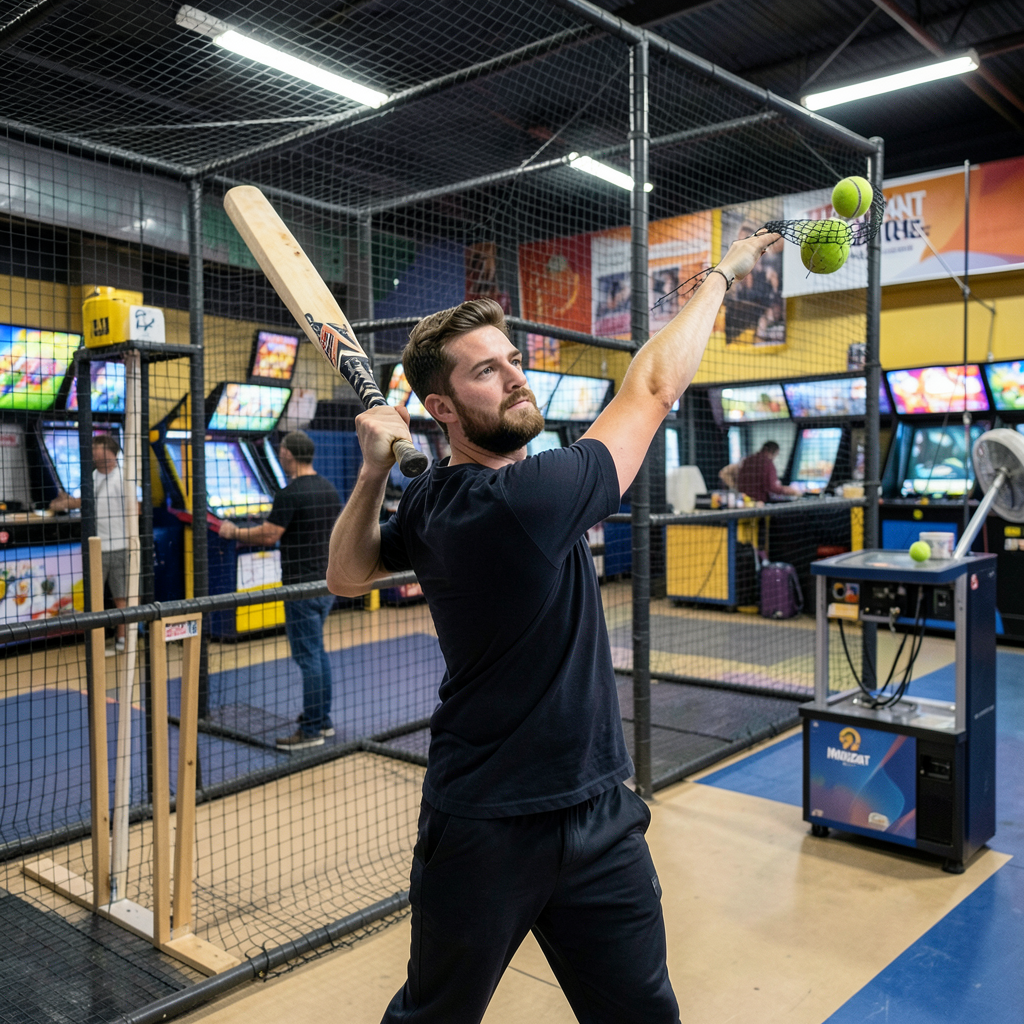

As a child, I always dreamed of this moment.
Taking on the legendary Jimmy Anderson.
My heart raced as he walked to the crease, delivered the ball, and completely dismissed me.
I’ll manage to get him eventually.
The reason this is possible is because this isn’t actual cricket – it’s the Howzat batting experience at Gravity MAX in Stratford.
Situated just beyond the Westfield shopping centre complex, this entertainment destination provides an extensive range of activities.
Classic arcade machines, mini-golf, and karting form part of the attractions.
Cricket facilities have only just been introduced over the past month or so, and as an enthusiast, I simply had to visit alongside a companion.
The team members proved welcoming and soon had us prepared for action.
Five distinct game options exist, beginning with the T20 format.
This mirrors the actual shortened version of the sport, with participants alternating to face complete overs.
Players select however many overs they prefer (maximum of 20) while difficulty spans five stages from novice through to elite professional standard.
Each difficulty tier was sampled and the variation between them proved substantial, so we’d suggest attempting levels 4 or 5 exclusively if you possess solid batting skills.
Nevertheless, considerable enjoyment awaits regardless of your standard.
The easier settings allow additional reaction time and a selection of bat dimensions and masses enables adjustment according to your competence level.
Survivor mode delivers head-to-head competition against fellow visitors.
Failing to post the highest run tally during an over results in losing one of your lives.
The hitting arena requires you to strike as many designated targets as possible within a predetermined ball count, thoroughly examining your precision.
One particular option permits you to abandon the bat entirely and evaluate your fielding technique.
Catch and throw involves projectiles being propelled towards you – we quickly discovered our poor catching ability – before releasing at a specific zone to accumulate points.
For those determined to challenge their batting prowess, World Cup mode grants two overs against virtual cricket icons such as Anderson, Dale Steyn, and Shane Warne generated by computer software.
Jofra Archer delivered a 76 miles-per-hour delivery that I could hardly perceive!
Ultimately, we thoroughly enjoyed ourselves and sufficient diversity exists to occupy a full sixty-minute session as we discovered.
The selection of difficulty settings and equipment ensures visitors of any age and skill level can discover something appropriate.
If you previously frequented Sixes Cricket – we attended on one occasion prior to its closure under administration during the previous year – then this establishment bears strong resemblance and you’ll certainly have an excellent time.
Factor in a respectable refreshment selection alongside numerous additional games available, and this represents an ideal choice for school holiday periods or an evening entertainment outing with companions.
Just remember to keep your focus firmly on the delivery!