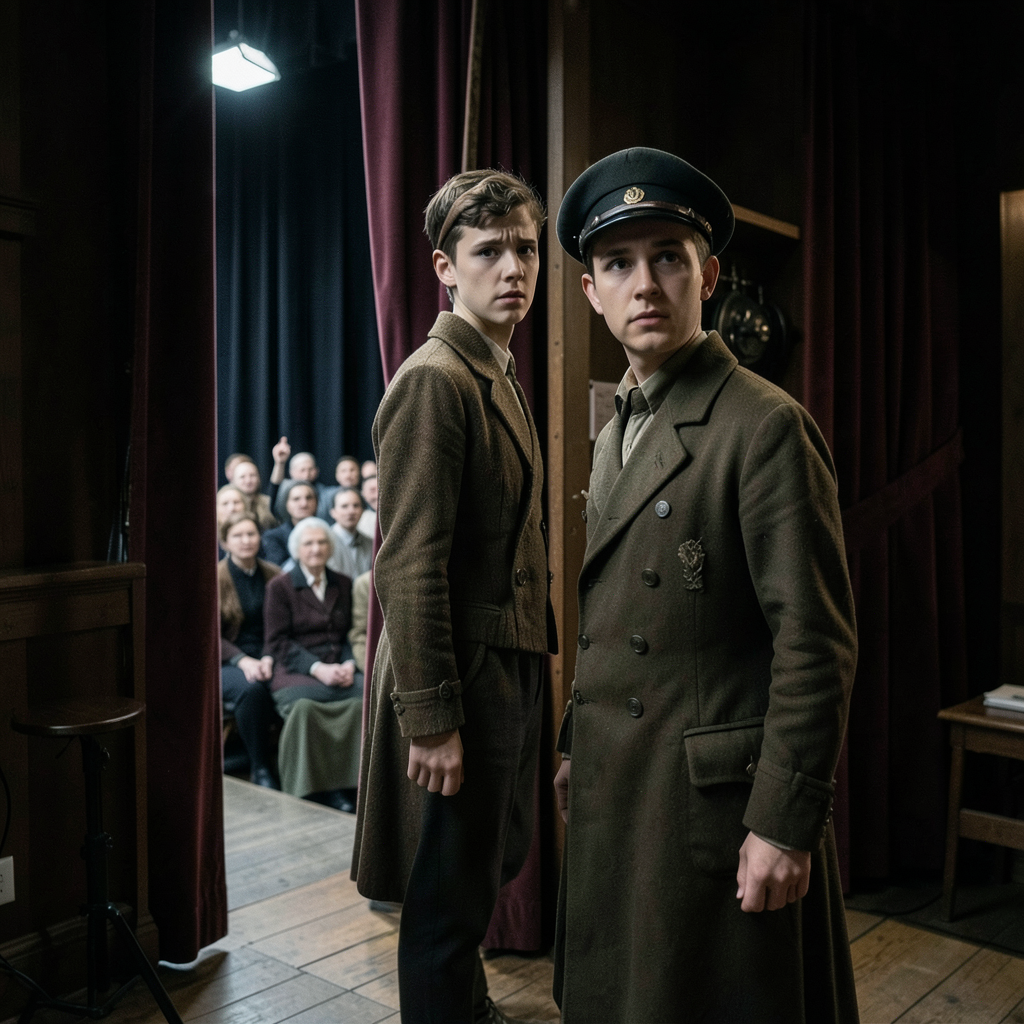

The musical history by Rosalind Adler and Lea Sellers commences backstage at Moscow’s Bolshoi Theatre during the 1934 premiere of Lady Macbeth of Mtsensk.
The opera achieved popular success, and attendees pushed forward to offer congratulations to the reticent twenty-five-year-old Dmitri Shostakovich.
However, anxiety spread when he learned that Stalin occupied a seat in the theatre.
Should the Soviet leader express disapproval, severe consequences loomed for the composer.
He had already mastered the art of reconciling creative expression with the demands of state authorities.
Should his work be deemed degenerate or subversive, the apparatus of state terror could result in arrest, vanishing, torment, or worse.
Stalin departed abruptly from the performance, and Shostakovich faced interrogation.
Under Kate Fahy’s staging, this nightmare sequence achieves remarkable impact through a solitary, unforgiving light and ominous offstage voices.
Fortuitously, the official scheduled to conduct the interrogation had himself been detained, leading to Shostakovich’s release.
Benjamin O’Mahony delivers an outstanding performance as Shostakovich, portraying a tormented figure who appears strikingly youthful, navigating precarious circumstances while endeavouring to evade scrutiny and political danger while still exercising his considerable artistic abilities.
His spouse Nina, portrayed with vibrancy by Jenna Augen, worked as a physicist though the audience learns little about her professional pursuits.
Instead, the character is burdened with dialogue referencing a woman allowing her own ambitions to fade while supporting her husband.
The observation holds validity, yet one wishes the writers had offered insight into her own work.
Nina proves supportive, practical, affectionate, and acknowledges his concealed musical messages, though greater exploration of this dynamic would have proved illuminating.
The narrative then depicts the gruelling 900-day Siege of Leningrad, encompassing starvation, utter devastation, and the struggle against bitter cold.
Shostakovich attained hero status when his Leningrad Symphony received broadcast transmission, and throughout the production moments of despair alternate with instances of triumph, including the momentous death of Stalin, presented as a dramatic turning point, alongside the persistent sense of walking on thin ice.
Without revealing the epilogue, the story transitions to colour-saturated scenes in Kansas as the now elderly composer approaches his end.
The production delivers an abundance of information about Shostakovich’s creative journey and influences, yet co-writers Adler and Sellers construct a sequence of visually striking and admirably performed scenes that, while engaging, leave certain dimensions underexplored.
Some observers might have preferred to eliminate the sentimental conclusion in favour of developing the earlier sequences more thoroughly.
Holy Fool continues at Park Theatre in Finsbury Park until October 10th.