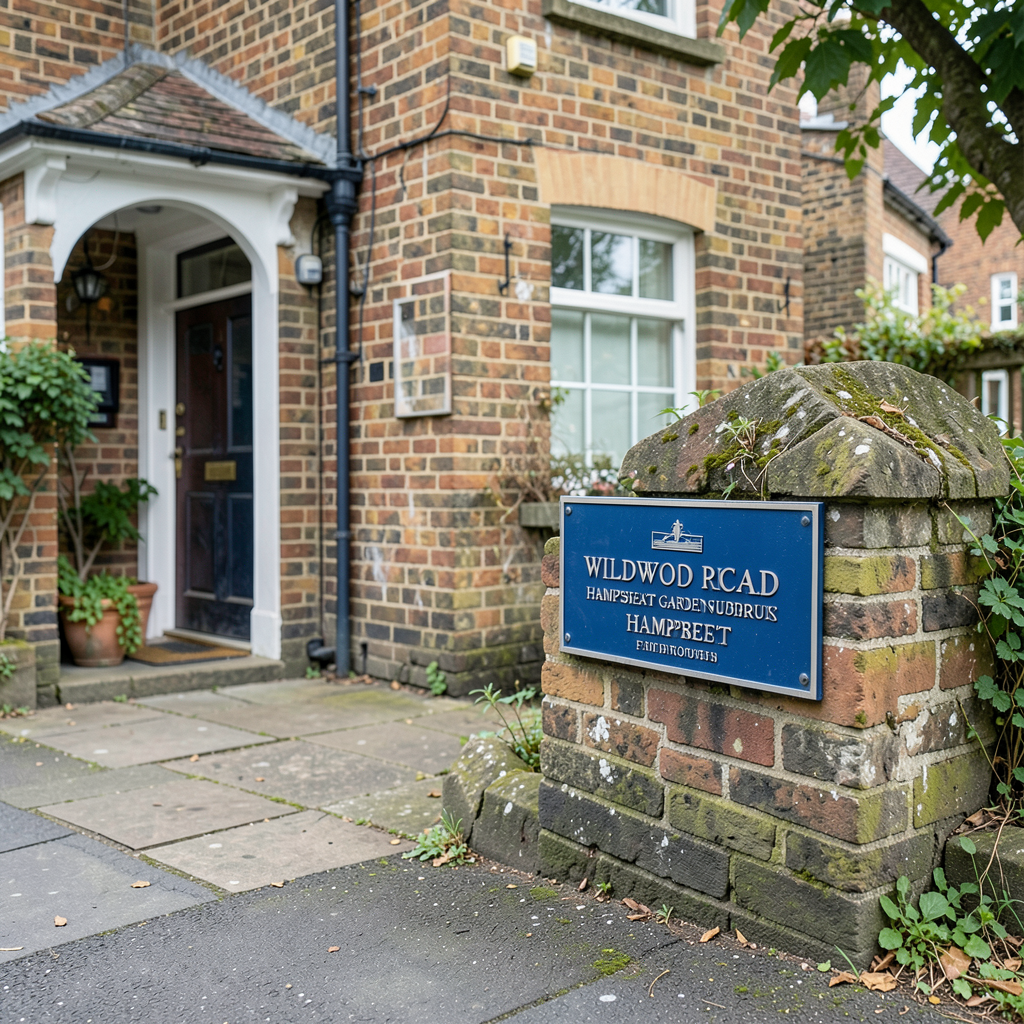

A blue plaque now marks the former Hampstead home of Frank Pick in Wildwood Road, Hampstead Garden Suburb.
The inscription names Pick as a pioneer of good design for London Transport and records that he lived at the house.
Pick resided there until his sudden death in 1941.
Passengers on the Tube encounter several elements of his work every day.
These include the network’s roundel, the Johnston typeface used for station signs and patterned upholstery found on trains, buses and trams.
His influence is also evident in stations from the 1920s and 1930s, particularly the circular ticket hall at Piccadilly Circus.
Pick was born in Lincolnshire in 1878.
He joined the North Eastern Railway in 1902 as a trainee manager before becoming personal assistant to its general manager, Sir George Gibb.
In 1906, Gibb took charge as managing director of the Underground Electric Railways Company of London and brought Pick with him.
The Underground Group had assumed control of the financially troubled District Railway and was opening three deep-level Tube lines.
By 1907, those lines were experiencing serious financial difficulties.
Albert Stanley, who was later known as Lord Ashfield, assumed control in an effort to rescue the business.
He gave his employees six months to reverse the company’s fortunes and granted Pick considerable freedom to develop its publicity.
Despite having no previous experience in the field, Pick introduced striking promotional posters to encourage travel.
He then began applying his ideas to stations, signage and wider branding.
One of his earliest initiatives came in 1908, when he helped establish a coordinated system intended to raise ticket sales.
Travellers could purchase tickets across several operating companies, while colour-coded maps presented the network as a whole.
Pick established the Underground Group’s Traffic Development and Advertising Department and became its commercial manager in 1912.
His approach to poster design moved away from text and towards imagery depicting attractions accessible by public transport.
Leading artists produced images highlighting theatres, zoos and parks for London passengers.
Pick also contributed to the planning of the transport system.
Following the Underground Group’s acquisition of the London General Omnibus Company in 1912, he assisted with the organisation and promotion of bus and Underground services.
He walked for miles to examine existing routes and identify potential destinations, helping establish new bus routes, services and connections with Underground stations.
These services and links were promoted through posters and became popular with commuters.
Another priority was to give the Underground a recognisable visual identity.
Pick tested a new typeface that could replace the varying styles previously used by individual companies.
In 1913, calligrapher Edward Johnston was commissioned to produce an official design.
Known first as Underground Railway Block and later simply as Johnston, the typeface standardised lettering across the network.
An updated form called Johnston100 remains in exclusive use by Transport for London.
Pick also set down detailed requirements covering proportions, colours and lettering, standards that continue to shape the network’s appearance.
As the Underground expanded during the 1920s and 1930s, Pick selected architect Charles Holden to create functional and accessible stations.
The projects included a new entrance at Westminster station in 1922, stations opened along the Northern line’s Morden extension in 1926, and stations serving the Piccadilly line extensions between 1931 and 1933.
Pick also brought established and emerging textile designers into the creation of branded moquette, the patterned upholstery still used on seats.
His rise within the organisation culminated in his appointment as managing director of the Underground Electric Railways Company of London in 1928.
With the Second World War approaching, he helped coordinate London Transport’s participation in the mass evacuation of civilians.
He left London Transport in 1940 after disagreeing with Lord Ashfield about government involvement in the organisation’s finances.
Pick then held a brief and unhappy position as director general of the Ministry of Information.
During that period, he clashed with prime minister Winston Churchill after declining to distribute false propaganda in Germany.
He died suddenly at his Hampstead residence shortly after retiring in 1941.
His work remains visible in the appearance of London’s transport system, from its signage and station architecture to its promotional imagery and patterned seating.