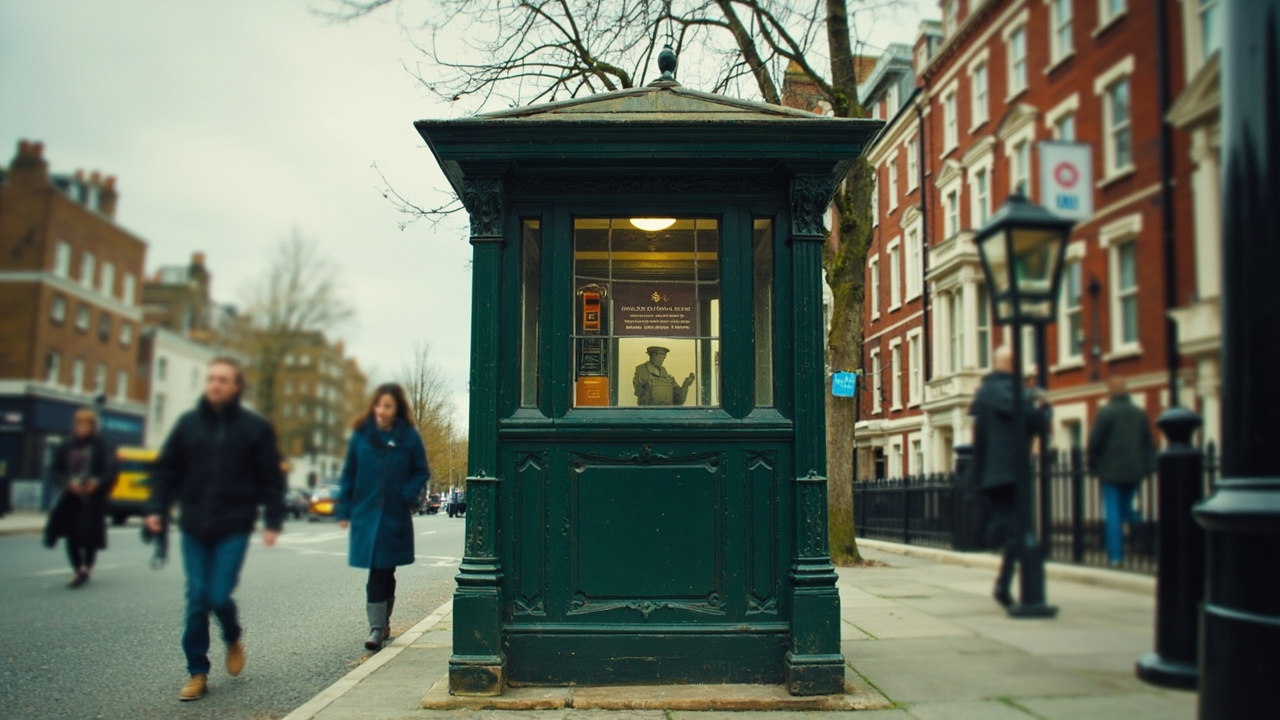

A small green structure close to Lord’s cricket ground received listed status recently, offering final protection to an unusual piece of London’s past.
Visitors walking through Chelsea, Pimlico or Kensington frequently notice these unique wooden booths positioned at the roadside or even in the middle of traffic and question their purpose.
Of the numerous Cabmen’s shelters that once existed throughout central London, only 13 survive today and each carries listed status.
The initial shelters appeared in 1875, offering London’s horse-drawn cab drivers a place to rest.
They originated in the 1870s, during a period when operators of horse-drawn hansom cabs lacked shelter from the elements yet were legally obligated to remain beside their vehicles.
Many drivers frequented nearby pubs for warmth and meals, leaving potential passengers waiting until they returned to collect their carriages.
George Armstrong, who edited The Globe newspaper, highlighted this issue in 1874 and advocated for purpose-built shelters for cab drivers.
Legend tells that he dispatched his servant into a tempestuous night to hail a carriage from St. John’s Wood to Fleet Street, only to find every driver huddled in the local pub.
Last year, the cabmen’s shelter on Wellington Place in St. John’s Wood became the final one of the remaining 13 structures to receive Grade II listing.
Charitable individuals including the 7th Earl of Shaftesbury established the Cabmen’s Shelter Fund in 1875 to construct small huts at taxi stands, providing hot non-alcoholic refreshments.
The very first shelter opened its doors on Acacia Road in St. John’s Wood during February 1875.
These structures were constructed from wood, painted a characteristic green, and sized no larger than a horse and cart to comply with Metropolitan Police regulations governing street installations.
The compact buildings contained a miniature kitchen with a wood-burning stove and ceiling vents, accommodating approximately a dozen cabmen.
Over 60 were erected at a cost of £150–£200 each, funded through local subscriptions.
However, the introduction of weather-protected motor taxis led to their decline, with many lost to road accidents, wartime bombing, and urban development projects.
By the late 20th century, their diminishing numbers prompted conservationists to secure listed status for the remaining structures.
Currently, the baker’s dozen of green shelters continue operating under the Cabmen’s Shelter Fund, offering licensed taxi drivers bacon sandwiches and tea, with the public also able to purchase items from a service window.
Beyond the Wellington Place location in St. John’s Wood, another shelter sits in the middle of the road outside Warwick Avenue Tube station.
A shelter in Russell Square was originally situated in the Haymarket and was presented by actor Sir Squire Bancroft. It was subsequently relocated to Leicester Square before moving once more during redevelopment.
Further north in Rosslyn Hill, Hampstead stands a more recent shelter constructed in 1935 to an alternate design.
This shelter was designed by Elisabeth Scott of Scott, Chesterton and Shepherd, built from elm with a cedar frame, concrete supports and metal windows.
It features an unusual mosaic decorative panel inscribed with THE WHARRIE SHELTER, displaying taxi-related imagery in a Cubist-inspired style.
The kiosk was donated by Mary Wharrie, daughter of Sir Henry Harben, first Mayor of Hampstead, replacing an earlier structure gifted to the Borough of Hampstead by the Harben family for cab drivers.